

How much does a pylon sign cost? If you are searching for a definitive, single-line answer, the market data can be perplexing. Prices generally range from $15,000 for a modest structure to well exceeding $100,000 for complex, architectural installations. This variance is not arbitrary; rather, it reflects the reality that a pylon sign is not merely a product pulled from inventory, but a custom-engineered construction project.
At Grandview, we approach pylon signage as a synthesis of structural engineering, brand architecture, and municipal compliance. The final valuation is a composite of three distinct pillars: physical fabrication specifications (scale, materials, and illumination), site-specific civil work (excavation and foundation), and professional services.

Defining the Asset: Pylon vs. Monument Architecture
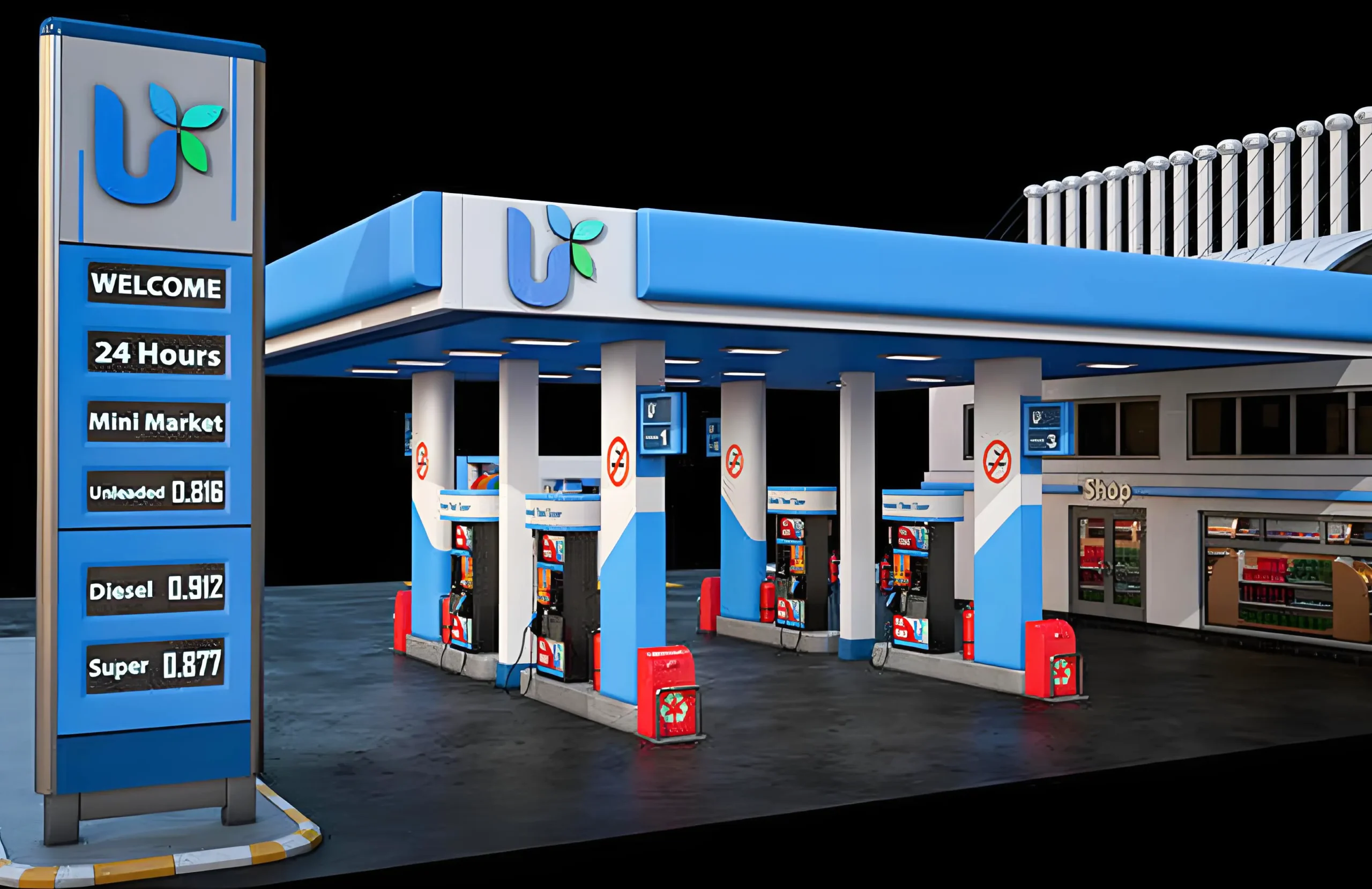
Before analyzing the ledger, it is critical to distinguish the architectural intent. When envisioning a commanding, vertical structure positioned to intercept the sightlines of high-velocity traffic, you are evaluating a pylon sign. Its primary function is long-range visibility, acting as a beacon to distinguish a commercial entity within a saturated visual landscape.
Conversely, a monument sign creates a ground-level, architectural presence. Typically integrated into a masonry or stone base, these structures serve as entry markers for corporate campuses or medical facilities. While monument signs signal prestige at the point of arrival, they lack the verticality required for highway acquisition.
For businesses requiring visibility from a quarter-mile distance, the pylon is the requisite solution. However, because pylon signs are subjected to significantly higher wind loads and structural stresses than monuments, their cost profile is inextricably linked to their engineering requirements.
The Primary Cost Driver: Structural Scale and Engineering
In the realm of pylon fabrication, verticality is the primary multiplier of cost. Increasing the height of a sign does not result in a linear price increase; the costs often compound exponentially. This is due to the physics of wind load and moment capability.
A 40-foot structure acts as a substantial “sail” in adverse weather. To ensure safety and longevity, the internal steel superstructure must be engineered to withstand specific wind pressures (measured in PSF—pounds per square foot) mandated by local building codes.
- Steel Fabrication: Taller signs require thicker wall gauges for the main support poles and more complex internal framing to prevent torsion.
- Foundation Work: The subterranean component—the concrete footing—is a major, often overlooked expense. A taller sign requires a deeper, wider excavation and a rebar-reinforced concrete cage to anchor the structure against leverage forces.
At Grandview, we do not guess at these specifications. We utilize precise engineering calculations to determine the necessary structural integrity, ensuring your investment stands firm against the elements.
Material Composition: Custom Fabrication vs. Standard Assemblies
Once the structural parameters are defined, the focus shifts to the aesthetic interface—the sign cabinet and cladding.
1. The Sign Cabinet
The most cost-efficient configuration is a standard aluminum sign cabinet with a polycarbonate face. This essentially functions as a durable, large-scale light box. It is an effective solution for straightforward branding and represents the entry-level baseline for pylon sign fabrication.
2. Architectural Enhancements
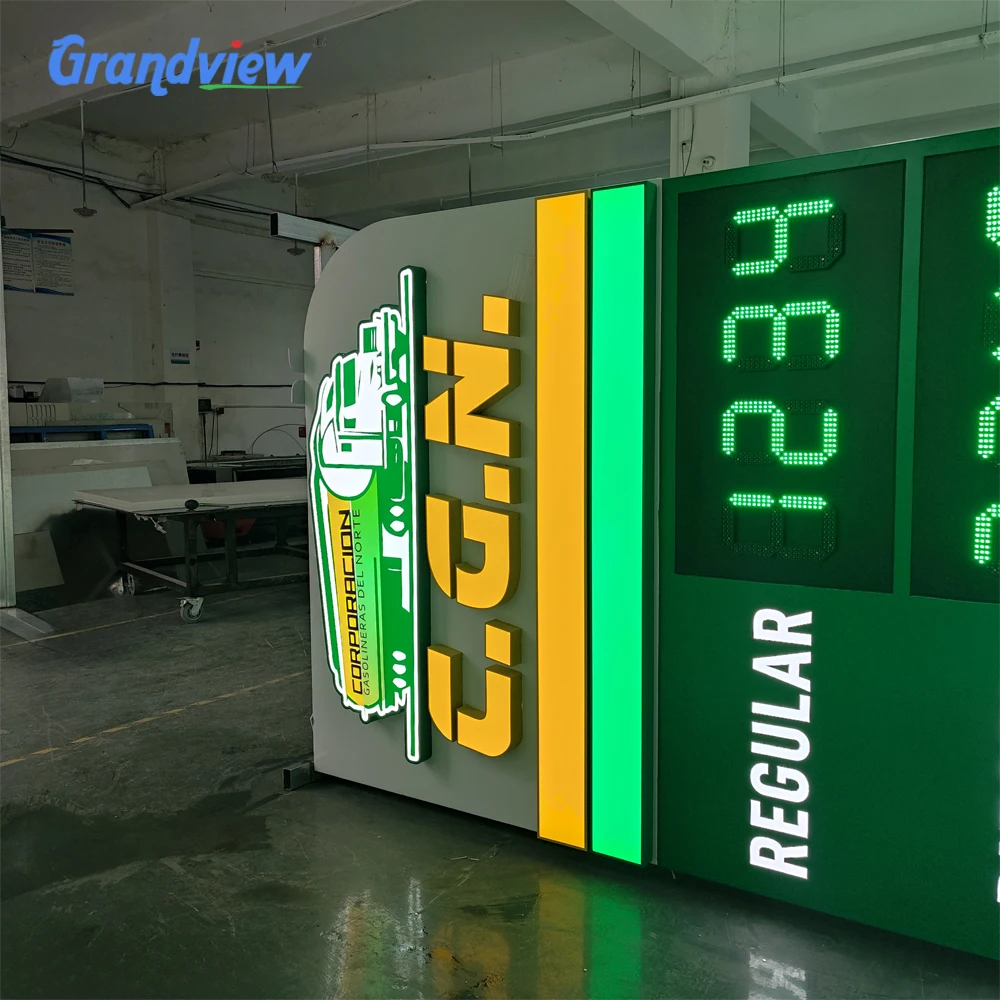
For brands requiring a distinct visual identity, the design may incorporate channel letters or custom-routed faces. These involve fabricating individual, three-dimensional alphanumeric characters or logos, often constructed from aluminum and acrylic. This process adds significant labor hours and material costs but results in a premium, architectural finish.
3. Multi-Tenant Considerations
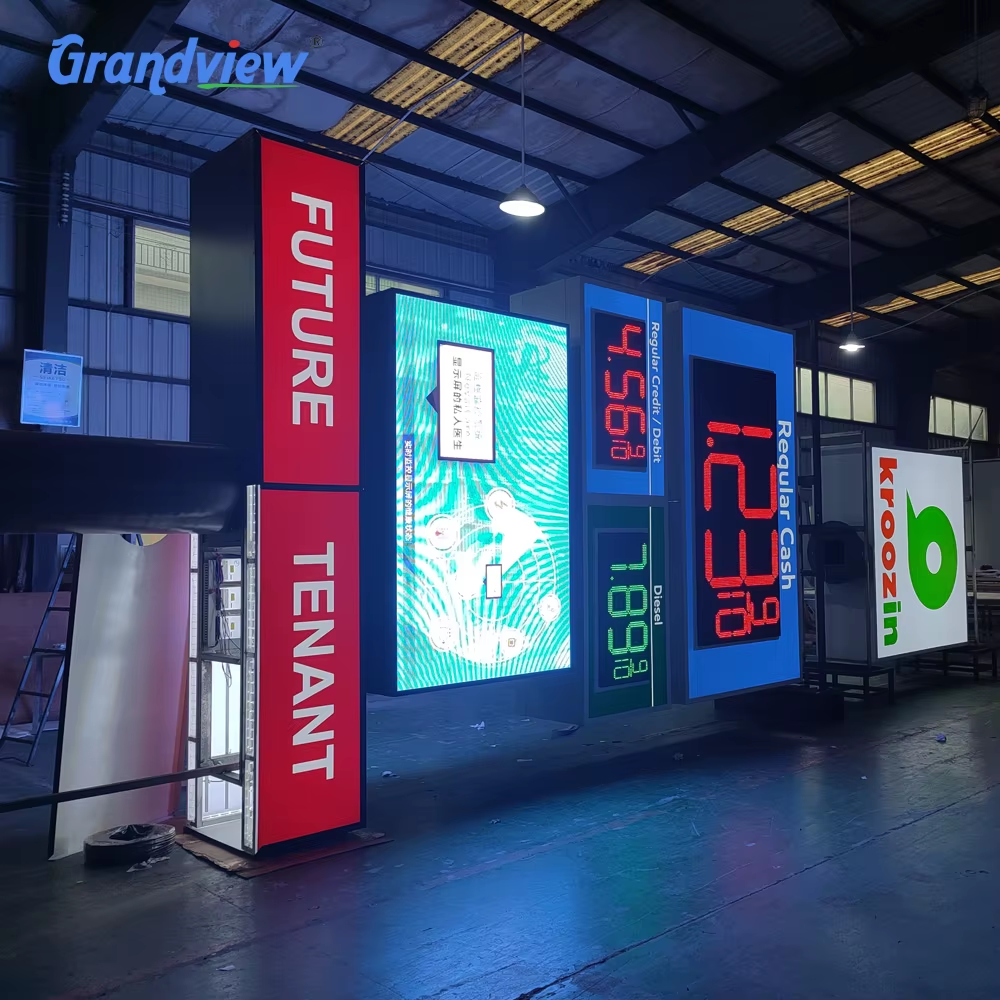
For shopping centers and industrial parks, the multi-tenant pylon is the standard. This structure features a main header for the property anchor, followed by a series of “divider bars” separating individual tenant panels. While the initial capital expenditure for the structure is high, the cost is amortized across multiple leases. Furthermore, the pylon sign insert cost—the price to replace a single tenant’s acrylic face—is relatively low, offering flexibility for future turnover.
Photometrics: Illumination and Energy Efficiency
A non-illuminated pylon sign loses 50% of its utility at sunset. Therefore, internal illumination is considered an industry standard for commercial viability. The technology utilized here directly impacts both the upfront quote and the long-term Total Cost of Ownership (TCO).
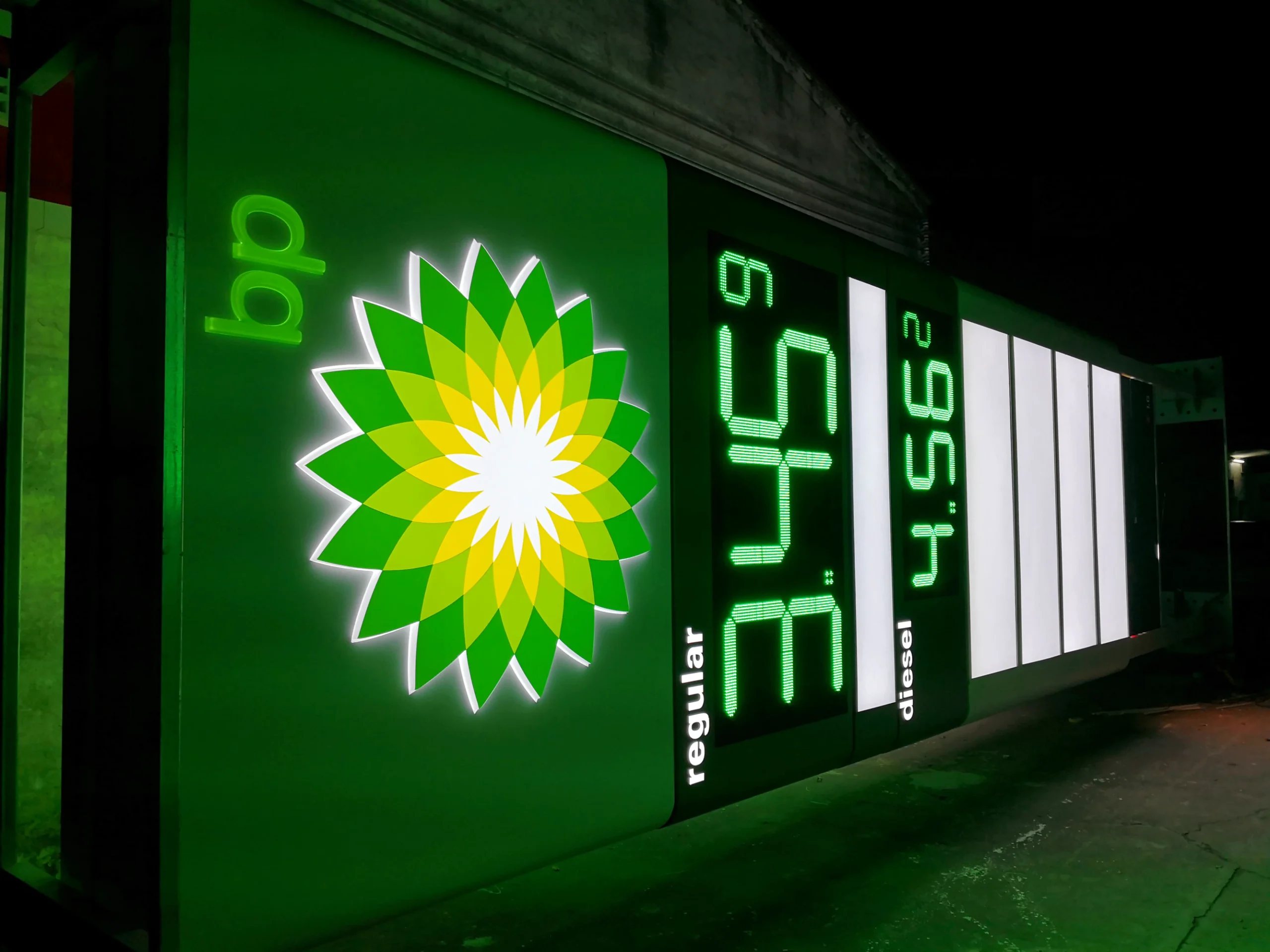
- LED Technology: Modern pylon signs utilize high-efficiency Light Emitting Diodes (LEDs). While high-quality LED modules and power supplies (drivers) carry a premium over legacy fluorescent systems, they offer superior lumen output, consistent light dispersion (eliminating “hot spots”), and a lifespan exceeding 50,000 hours.
- Electronic Message Centers (EMCs): Integrating a digital LED display significantly escalates the budget, often adding $15,000 to $30,000 depending on pixel pitch (resolution). However, an EMC transforms a static sign into a dynamic communication platform.

The “Soft Costs”: Permitting, Logistics, and Installation
A comprehensive quote includes the “soft costs” that facilitate the legal and physical reality of the sign. These are non-negotiable professional services.
- Permitting and Acquisition: Before metal is cut, the project must navigate municipal bureaucracy. This involves zoning analysis and the procurement of building permits.
- Installation Logistics: The installation of a pylon sign is a heavy construction operation. It necessitates excavation equipment, concrete procurement, crane services, and licensed electrical labor.
These logistical elements can account for 30% to 40% of the total project budget. When evaluating the cost of a pylon sign, it is imperative to verify that your estimate is “turnkey”—inclusive of these essential site services.
ROI Analysis: Viewing Expense as Investment
While a capital expenditure of $25,000 to $50,000+ is substantial, it must be contextualized against the asset’s lifespan. A structurally sound, well-fabricated pylon sign from Grandview is built to last 15 to 20 years or more.
Mathematically, a $30,000 asset amortized over a 10-year period equates to approximately $8.21 per day. For a marketing channel that operates 24/7/365, provides distinct wayfinding, and captures thousands of daily impressions, the Cost Per Thousand Impressions (CPM) is significantly lower than digital advertising, radio, or print media.

The Grandview Advantage: Factory-Direct Precision
To transition from a rough estimate to an actionable proposal, specificity is required. As a dedicated manufacturer, Grandview streamlines this process to provide transparency and eliminate unnecessary middleman markups.
To expedite your consultation, consider the following parameters:
- Site Location: For zoning and wind load analysis.
- Visual Assets: Vector-based logo files (AI, EPS) for design scaling.
- Illumination Requirements: Standard LED backlighting or dynamic EMC capabilities.
A pylon sign is a landmark decision for your business. By understanding the engineering and logistical factors that influence the price, you can navigate the market with confidence.