

Choosing signage materials is not just about picking aluminum, acrylic, PVC, or steel. Most commercial signs use several materials at once. Each part has a different job.
So, start with the part of the sign first. Then choose a material that fits that job. Also consider where the sign will be used, how it will be mounted, and whether it needs lighting.
Start With the Sign Part, Not the Material Name
A commercial sign is a system, not one sheet of material.
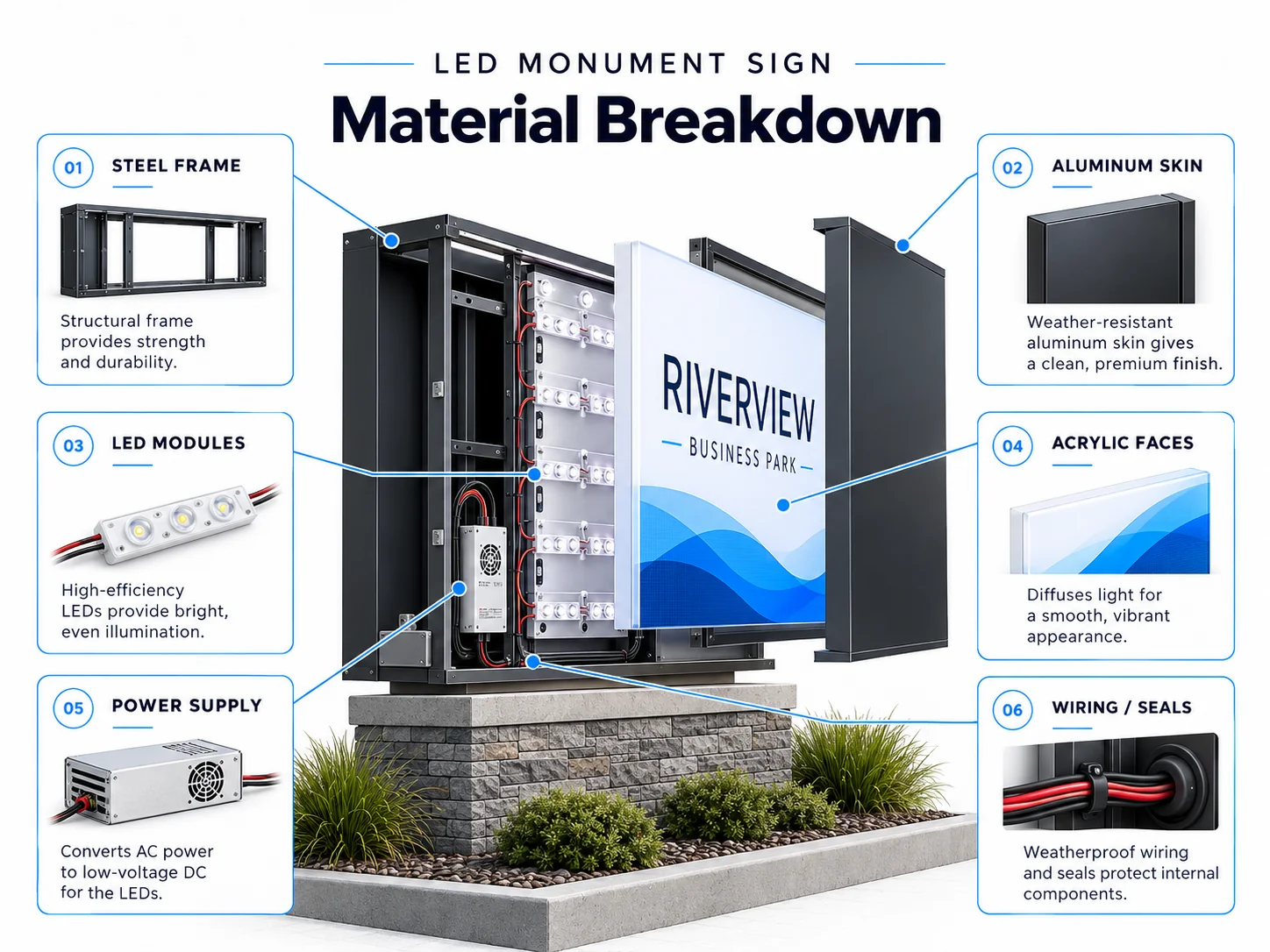
For example, an illuminated sign may use a metal frame, an aluminum cabinet, an acrylic or polycarbonate face, vinyl graphics, and LED modules. Channel letters may use an acrylic face, aluminum returns, a back panel, and internal LEDs.
Because of this, terms such as “aluminum sign” or “acrylic sign” do not tell you enough. Instead, ask what each part needs to do.
| Sign Component | Common Material Direction | Main Job | What Can Change the Choice |
|---|---|---|---|
| Structural frame | Steel / aluminum | Support the sign | Size and site engineering |
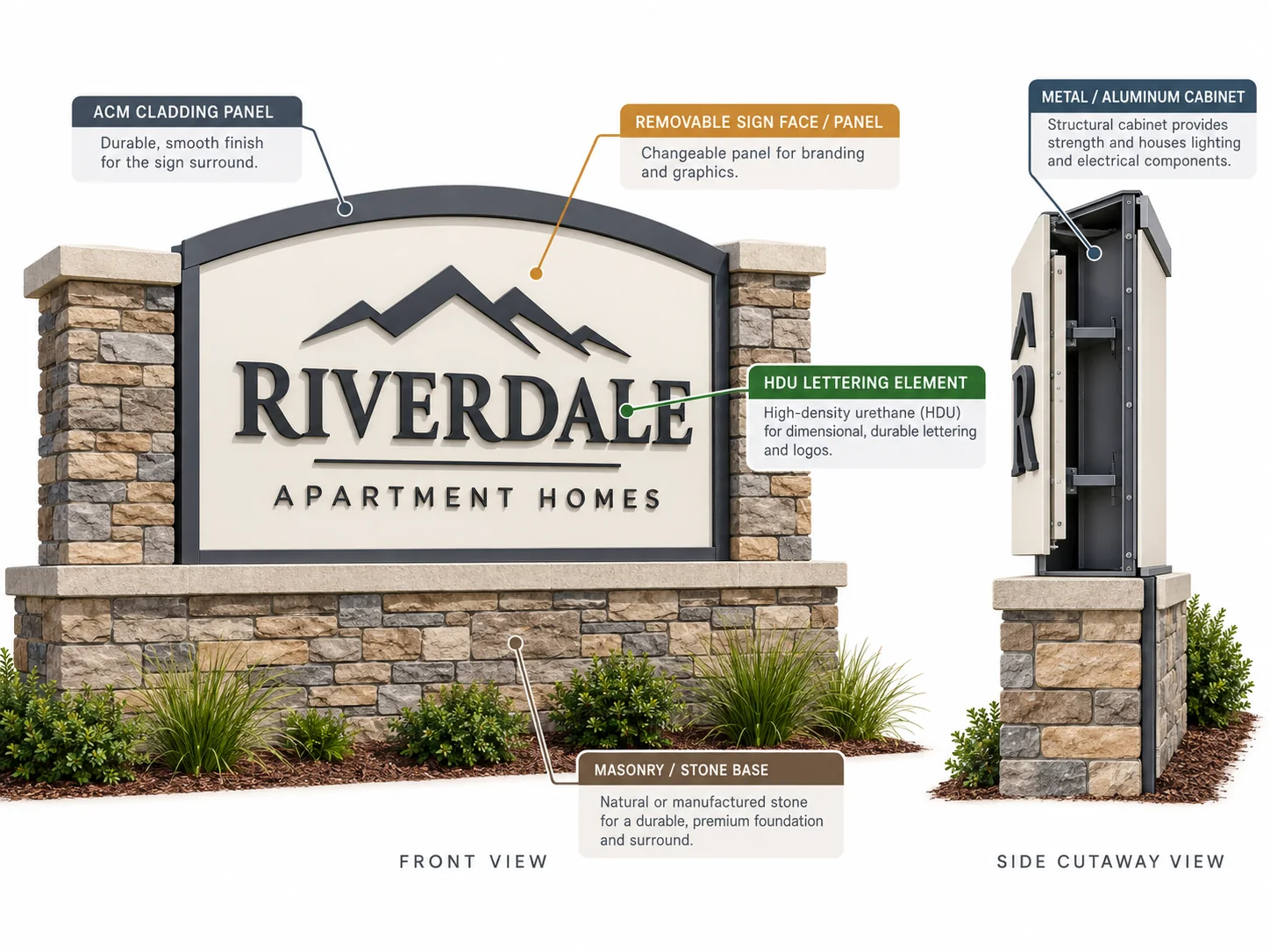
| Cabinet / return | Aluminum / fabricated metal | Form and protect the sign | Shape, finish, fabrication |
| Illuminated face | Acrylic / polycarbonate | Show graphics and spread light | UV exposure, impact, cabinet depth |
| Flat panel | ACM / aluminum / selected PVC | Create a rigid display surface | Span, support, environment |
| Graphic layer | Vinyl / printed film | Carry color and branding | Surface and exposure |
For some sign types, the details need a closer look. Pylon sign faces, for example, have different needs from exterior dimensional letters.
What Changes the Material Choice?

The same material can work well in one project and poorly in another. Therefore, site conditions matter.
First, think about outdoor exposure. Sun, heat, moisture, and temperature changes can affect plastics, coatings, adhesives, and flat panels.
Next, think about size and support. A small panel and a large panel should not always use the same thickness or fixing method.
Lighting also changes the decision. An acrylic or polycarbonate face cannot be judged by appearance alone. Cabinet depth, LED layout, and light spread also affect the final result.
For electric signs, the electrical environment matters as well. UL has separate requirements for complete electric signs, sign components, and LED sign kits. This is one reason illuminated signs should be reviewed as complete systems rather than as separate parts.
Where Material Choices Usually Go Wrong
One common mistake is treating a material name as a full specification.
For example, “PVC” does not tell you the grade, thickness, support method, or intended use. Some products are made for tougher outdoor conditions than others. So, the exact product information matters.
The same is true for acrylic and polycarbonate. Different grades may be designed for different levels of UV exposure, impact, forming, or sign-face use.
Mounting can also change the result. A panel may look suitable on paper. However, poor support or the wrong fixing method can still create problems.
Illuminated signs have a similar issue. A suitable face material will not give even light if the cabinet is too shallow or the LED layout does not match the face.
Review the Specification Before Fabrication
Before production starts, the drawing should define more than the material name.
Depending on the part, it may need to show:
- material type or grade;
- thickness;
- surface finish;
- component location;
- lighting needs;
- how the part connects to nearby parts.
This is especially important for LED channel letters. The face, return, backing, and lighting system work together. Therefore, they should be reviewed as one assembly.
However, some items remain local. Structural calculations, foundations, permits, site electrical work, and installation depend on the project location and local requirements.
FAQ
What are the most common signage materials?
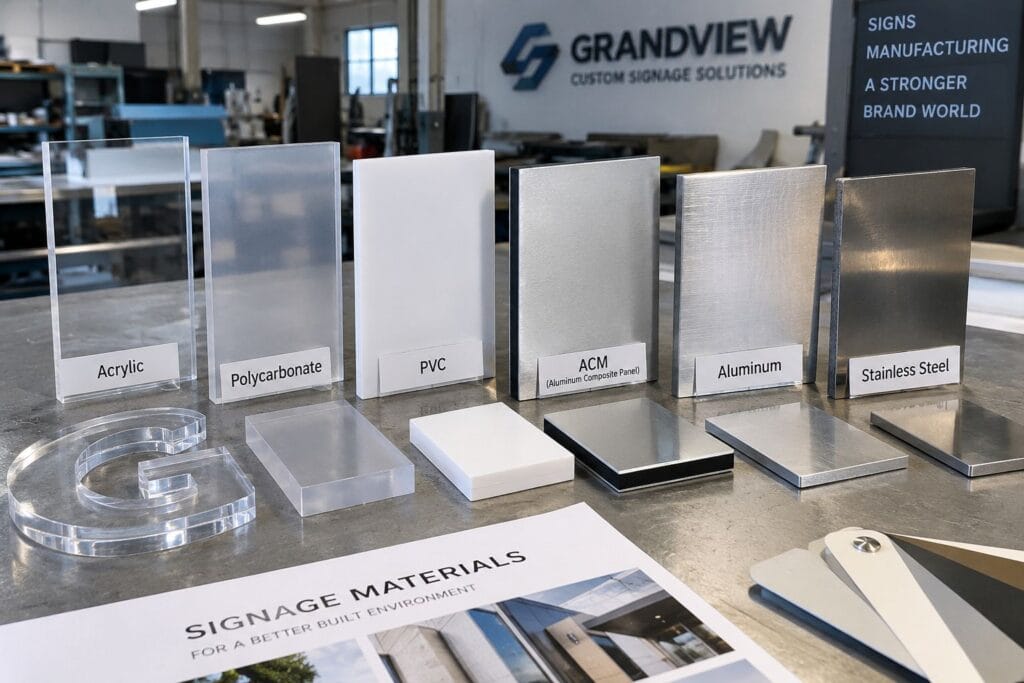
Common signage materials include aluminum, steel, acrylic, polycarbonate, ACM, PVC, and vinyl. However, they are not interchangeable. Each material usually serves a different role in the finished sign.
What is the best material for outdoor signage?
There is no single best option. Instead, the choice depends on the sign part, exposure, size, finish, mounting method, and intended use. In many cases, the exact grade and construction matter more than the material name.
If you already have a proposed sign construction, Grandview can review the material, face, cabinet, and lighting details before fabrication.
References / Further Reading
UL Solutions — Electric Sign and Sign Component Manufacturers