

A double-pole pylon sign is not simply a stronger version of a single-pole sign. Instead, each layout works with a different cabinet and support design.
So, the key question is not just, “Do I need one pole or two?” The better question is:
What support layout works best with the sign cabinet and the site?
The Main Difference Is How the Cabinet Connects to the Poles
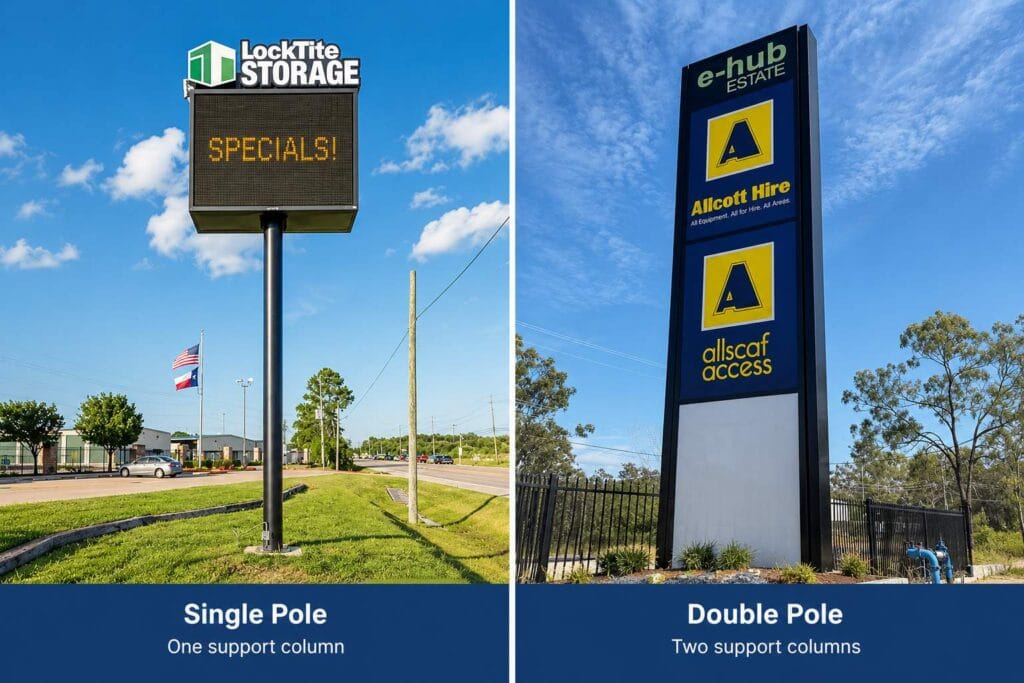
Single-pole and double-pole describe the support structure. They do not describe the number of sign faces.
For example, a single-pole sign can still have two sign faces. Drivers can read it from both directions. A double-pole sign can also use one or two faces.
Therefore, pole count and viewing direction are two separate decisions.
A single-pole design uses one main support point. By contrast, a double-pole design uses two support points across the cabinet.
As a result, the two layouts may need different:
- internal frames;
- pole spacing;
- mounting points;
- cabinet connections.
This is why the cabinet should guide the support layout.
When Does a Single-Pole Sign Make Sense?
Single-pole signs often work well with compact cabinets and simple sign layouts.
For example, they are common for:
- single-tenant roadside signs;
- standalone retail stores;
- narrower illuminated cabinets;
- projects that need a clean central support.
A single pole can also give the sign a lighter and simpler look.
However, there is no fixed cabinet width that automatically requires two poles. Site conditions also matter.
The sign height, cabinet shape, wind conditions, foundation, and local engineering rules can all affect the final design.
So, local engineers should confirm the final support structure for each site.
For wider planning issues, see our guide to commercial pylon sign planning.
When Do Two Poles Become More Practical?
Two poles often make more sense when the cabinet becomes wider or carries more sign panels.
For example, shopping centers often use larger cabinets with several tenant panels. In that case, two support points can work better with the width of the sign.
Still, this does not mean that every large sign needs two poles.
Instead, the project team should look at the whole sign:
cabinet + internal frame + poles + connections + foundation
All of these parts work together.
This is especially important for multi-tenant pylon signs, because more tenant panels often lead to a larger cabinet.
| Project Condition | Single Pole | Double Pole |
|---|---|---|
| Compact single-tenant cabinet | Common | Often not needed |
| Wider cabinet | Possible | Often considered |
| Several tenant panels | Possible | Common |
| Central support appearance | Good fit | Different appearance |
| Two support points | No | Yes |
| Final structural approval | Site-specific | Site-specific |
What Changes Inside the Sign Cabinet?

This is where the real difference becomes clearer.
A pole does not simply hold the cabinet from below. The internal frame also needs to connect the cabinet to the support structure.
With a single-pole design, the internal frame usually transfers the load toward one main support area.
With two poles, the frame needs to connect with two support points. Therefore, pole spacing and cabinet framing need to match.
This can affect:
- internal cross members;
- support locations;
- cabinet sections;
- connection details.
In practice, this also matters when replacing an old sign cabinet.
A wider new cabinet may place different demands on an existing pole. So, you should not treat a cabinet replacement as a simple visual update.
Our pole sign retrofit vs replacement guide explains this issue in more detail.
One Pole or Two Does Not Replace Structural Engineering
Pole count alone cannot tell you whether a sign structure is safe.
A sign manufacturer can handle the cabinet, internal frame, faces, lighting, finishes, and fabrication details.
However, local professionals need to handle site-specific work. This can include:
- foundation design;
- wind-load calculations;
- structural approval;
- permits;
- local codes;
- onsite electrical work;
- installation.
Standards such as ASCE 7 also treat freestanding sign loads as a project-specific engineering issue.
So, the practical rule is simple:
Start with the cabinet and the project needs. Then choose a support layout that local engineers can approve for the site.
For more detail on local installation responsibilities, see our pylon sign installation guide.
FAQ
Can a single-pole sign be double-sided?
Yes. Pole count and sign-face count are separate choices.
Is a double-pole sign always stronger?
No. The full sign system determines structural performance. The cabinet, poles, connections, foundation, and site conditions all matter.